Research
My research sits at the intersection of climate dynamics, tropical meteorology, and machine learning. I am broadly interested in understanding how the climate system responds to natural and anthropogenic forcing, with a focus on extreme weather events — particularly tropical cyclones.
Climate Model Biases and SST Patterns
A persistent challenge in climate science is that coupled climate models often misrepresent sea surface temperature (SST) patterns — most notably the “double-ITCZ” bias and the associated warm bias in the eastern Pacific cold tongue. My work investigates how these biases distort the simulated climate response to external forcing (e.g., aerosol reductions, Antarctic ozone depletion), and develops flux adjustment techniques to correct them.
-
Under review
Eastern Pacific Cooling due to Northern Hemisphere Aerosol Reduction, and the Role of Model Bias
How aerosol-driven cooling in the eastern Pacific is distorted by long-standing model SST biases, and what flux adjustment recovers.

-
In prep
A Muted Tropical Eastern Pacific Cooling Response to the Antarctic Ozone Hole, Linked to Double-ITCZ Bias
Tracing how the double-ITCZ bias mutes the simulated eastern Pacific response to Antarctic ozone depletion.
-
J. Climate, 2025
A More La Niña–Like Response to Radiative Forcing after Flux Adjustment in CESM2
Correcting CESM2's mean-state SST bias with flux adjustment changes the model's forced response toward a more La Niña–like pattern.
-
Tropical Cyclone Activity under Climate Change
Understanding how tropical cyclone (TC) frequency, intensity, and hazard respond to both natural variability and long-term warming is central to climate risk assessment. I study how SST warming patterns — whether from model bias or real-world forcing — modulate TC activity, and re-examine historical TC frequency trends using improved observational methods.
-
GRL, Under review
Impact of Sea Surface Temperature Trend Biases on Tropical Cyclone Activity and Hazard
How trend biases in simulated SST patterns propagate into projected tropical cyclone activity and hazard.

-
GRL, 2026
Re-examining Historical Trends of Tropical Cyclone Frequency
Revisiting long-term TC frequency trends once observational heterogeneities across the record are accounted for.
-
npj Clim Atmos Sci, 2025
The Response of Tropical Cyclone Hazard to Natural and Forced Patterns of Warming
Disentangling how natural and forced warming patterns each shape projected tropical cyclone hazard.
-
Physics-Informed Machine Learning for Tropical Cyclones
Satellite imagery offers a continuous, global record of TC structure, but translating raw imagery into reliable intensity and size estimates remains difficult. I develop deep learning models that incorporate physical constraints to improve these estimates, and apply them to build long, homogeneous datasets of TC inner-to-outer size.
-
Mon. Wea. Rev., 2021
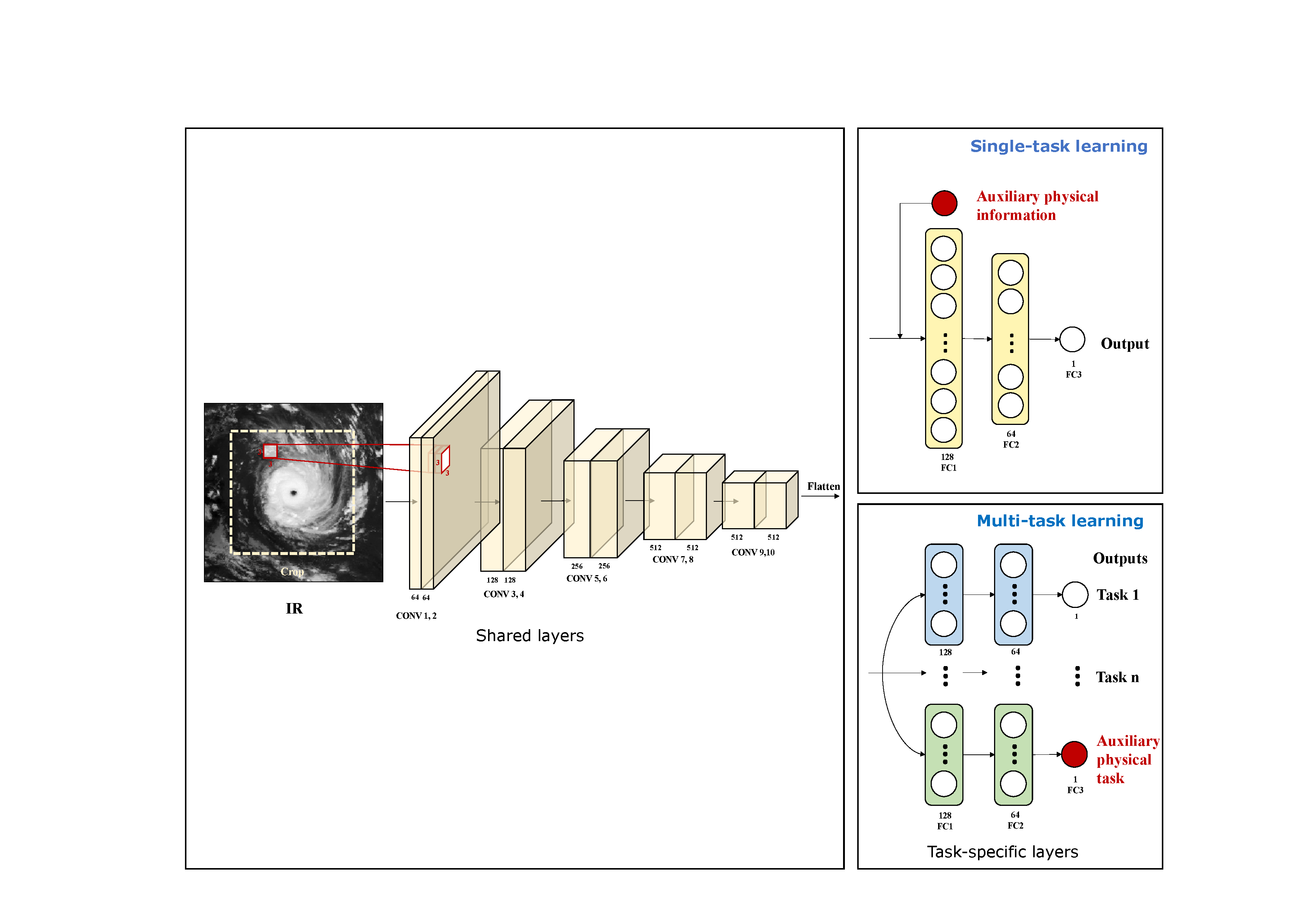
Physics-Augmented Deep Learning to Improve Tropical Cyclone Intensity and Size Estimation from Satellite Imagery
Injecting physical constraints into a CNN improves intensity and size estimates from IR satellite imagery; now used operationally by the China National Satellite Meteorological Center.
-
J. Climate, 2023
A Deep-Learning Reconstruction of Tropical Cyclone Size Metrics (1981–2017): Examining Trends
A homogeneous 37-year record of TC inner-to-outer size, reconstructed with deep learning, used to examine long-term size trends.

-
JGR: Machine Learning and Computation, 2026
Detection of Eye Occurrence in Sequential Satellite Infrared Imagery and Its Application to Improve Deep Learning-Based Tropical Cyclone Intensity Estimation
Detecting eye occurrence across image sequences sharpens deep-learning intensity estimates.
-
GRL, 2026
Integrating Diurnal Pulsing Signatures for AI-Driven Tropical Cyclone Intensity Prediction
Diurnal pulsing signatures, folded into an AI model, improve short-term TC intensity prediction.
-
Open data, since 2021
deeptcnet
Real-time, deep learning–based tropical cyclone intensity and size monitoring.
-